
MVP Cost Calculator – Find Out Your Startup’s MVP Cost in 2026


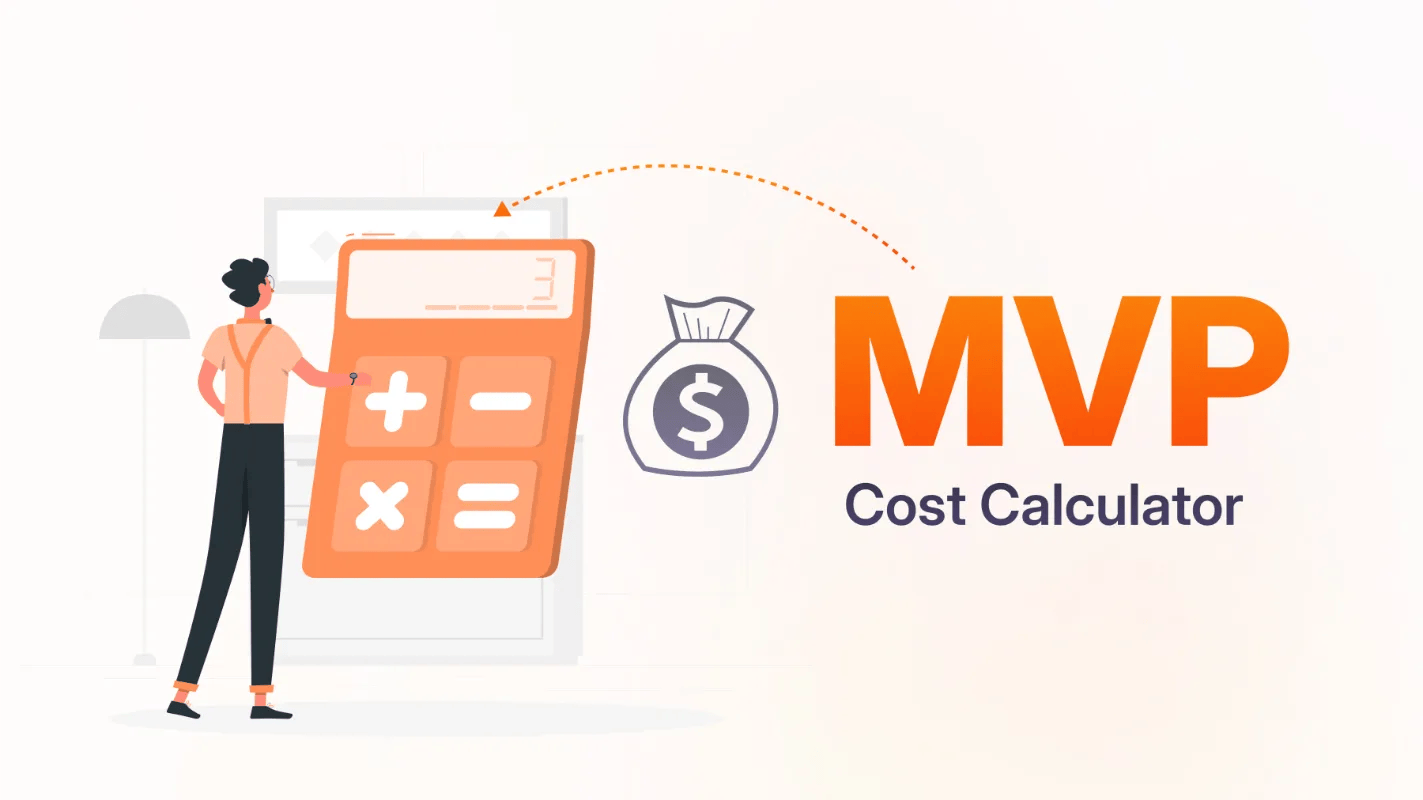
Here’s a situation many founders face. You have a strong idea, you sketch out a rough product, you run it by a few friends, and then someone asks, “How much is this going to cost?” You pull a number out of thin air. Maybe $15K. Maybe $50K. You Google it and still feel no more certain than before.
That uncertainty isn’t a failure of research. It’s the nature of MVP development, because cost isn’t one thing. It’s a combination of decisions you make, some early and some late, that stack up in ways that aren’t obvious until you’re already mid-build.
Underestimate, and you run out of runway before you’ve proven anything. Overestimate, and you scare away co-founders or investors before you’ve even started. Either way, the wrong number costs you.
That’s why we built a realistic, tailored way to estimate cost based on the specific shape of what you’re building, rather than a ballpark pulled from someone else’s project. In this guide, we walk through everything that goes into that number so you actually understand it, not just receive it.
What Is an MVP?
An MVP is the earliest version of your product that delivers real value to a specific user, and nothing more. Not a prototype. Not a beta. Not a watered-down version of your grand vision. An MVP is a deliberate, strategic decision about what to not build yet, ruthlessly scoped to answer one question: does removing this break the core value for the user? If the answer is no, it doesn’t ship.
It’s a deliberately scoped product designed to answer one question: does this idea work in the real world?
The term was popularized by Eric Ries in The Lean Startup, but the concept predates the label. Build the least expensive version of your idea that still proves or disproves your core assumption, then decide what to do next based on evidence, not instinct. To understand how MVP in software development applies to your specific product type, start with the problem you are trying to prove or disprove.
MVP vs Prototype vs Full Product
These three terms get used interchangeably, but they’re meaningfully different:
The biggest mistake founders make is building a full product when they need an MVP, or building a prototype when they actually need an MVP. Knowing where you are in that spectrum changes your entire budget conversation.
How Technext’s MVP Cost Calculator Works
The Technext MVP Cost Calculator gives you a realistic project estimate in minutes, without requiring you to speak to a salesperson first.
Step 1: Choose your product type. SaaS, mobile app, marketplace, AI-powered product, or something else. Each selection loads a relevant set of default assumptions.
Step 2: Select features and complexity. A curated list of common MVP features, each tagged with complexity level (simple, moderate, complex). You choose what you need and leave out what you don’t.
Step 3: Choose your platform(s). Web, iOS, Android, or a combination. Each adds to the estimate in proportion to the actual development effort involved.
Step 4: Review integrations and extras. Payment processing, third-party APIs, CMS, analytics, and AI model integration. Select what applies. Each is priced based on real implementation experience, not guesswork.
Step 5: Get your detailed cost estimate. A breakdown of estimated hours by component, a cost range based on different development approaches, and a recommended timeline.
The whole process takes about five minutes. You adjust inputs in real time and watch how the estimate changes, which is often more useful than the final number itself, because it shows you which decisions have the biggest impact on cost.
Why Startups Build MVPs First
Most startups build MVPs because they’re terrified of spending a year building something nobody wants.
That fear is justified. The startup graveyard is full of beautifully engineered products that solved problems users didn’t actually have.
Building a full product before validating demand is one of the most expensive mistakes a founder makes. An MVP is your way of finding out you’re wrong before it costs you everything. An MVP lets you:
Test ideas faster. Instead of spending 12 to 18 months building something, you spend 3 to 6 months building enough to get real user reactions. That feedback loop drives smart product decisions.
Reduce financial exposure. If the idea doesn’t work, you find out after spending $20K instead of $200K. That’s not a failure, that’s efficient learning.
Attract early adopters and investors. A working MVP is far more persuasive than a pitch deck. It demonstrates execution, not just ideation.
Collect data that actually shapes the product. You learn what features users actually use (rarely what you expected), what confuses them, and what makes them come back.
If you are ready to move from understanding why to knowing how, here is the guide to MVP web development that covers the full process from problem definition to launch. The MVP Cost Calculator from Technext makes that scope conversation explicit. The more specific you are, the more accurate the estimate.
How MVP Costs Are Actually Calculated
MVP cost comes down to four variables: scope, time, rate, and risk. How they combine is what separates a realistic estimate from a guess.

There’s no standard formula for MVP cost. What you’ll find online are averages, and averages are almost useless for planning because they flatten the variables that actually determine your number.
Cost is the product of four things:
Scope: How many features are you building, and how complex each one is?
Time: How many hours does a developer need to build and test the features?
Rate: How much you pay per hour, based on who’s doing the work and where they’re from.
Risk: The extra costs that show up when requirements aren’t clear, timelines are too tight, or integrations get tricky.
Everything else flows from those four factors. When an agency gives you a quote, they estimate scope and time, multiply by their rate, and add a buffer for risk. When that estimate turns out to be wrong, and it often does, the cause is usually that the scope wasn’t defined clearly enough up front, or something unexpectedly complex showed up mid-build.
The MVP Cost Calculator from Technext makes that scope conversation explicit. The more specific you are, the more accurate the estimate.
Typical MVP Costs by Project Type
Different product categories have fundamentally different cost structures. Here’s a grounded breakdown of what each type typically involves in 2026:
SaaS MVP
A SaaS MVP is usually a web application that solves a specific workflow problem for a defined user type. Think project management for freelancers, invoicing for small agencies, or scheduling for clinics.
Core features typically include user authentication, a dashboard, the core workflow feature, basic settings, and a payment integration if you’re charging from day one.
Estimated cost range: $18,000 to $55,000
Timeline: 8 to 16 weeks
Team: 1 backend developer, 1 frontend developer, 1 designer, part-time QA
The range is wide because it depends heavily on how custom the core feature is. A SaaS built on commodity functionality sits at the lower end. One with a novel workflow engine or complex data modeling sits higher.
Mobile App MVP
Mobile adds cost because you’re dealing with device diversity, app store submission, and often both iOS and Android if your users span both platforms.
Core features: onboarding flow, user profiles, the primary use-case screen(s), push notifications, and basic analytics.
Estimated cost range: $25,000 to $80,000
Timeline: 12 to 20 weeks
Team: 1 to 2 mobile developers, 1 backend developer, 1 designer, QA
Cross-platform frameworks like Flutter or React Native reduce cost by 30 to 40% compared to building native iOS and Android separately, but they come with trade-offs in performance and access to platform-specific features.
Marketplace MVP
Marketplaces are structurally more complex than single-sided products because you have two user types (buyers and sellers), and serving both well from day one is genuinely hard. You also need a payment flow that handles split transactions, holds, and potentially refunds.
Core features: separate onboarding for each user type, listing creation, search and filters, a messaging system, payment processing with escrow or payout logic, and basic trust/review features.
Estimated cost range: $40,000 to $120,000
Timeline: 16 to 28 weeks
Team: 2 backend developers, 1 to 2 frontend developers, 1 designer, QA
Don’t underestimate the payment complexity. Stripe Connect, for example, is powerful but has its own learning curve, and getting payouts right takes time.
AI-Powered App MVP
AI-powered MVPs vary the most in cost because “AI” means anything from a wrapper around a hosted LLM API to a custom-trained model on proprietary data. For most startups, the former is the right starting point.
Core features: the AI interaction layer (chat interface, output display, etc.), user authentication, prompt management, usage tracking (especially important for cost control), and feedback mechanisms so users can rate outputs.
Estimated cost range: $30,000 to $100,000
Timeline: 10 to 24 weeks
Team: 1 AI/ML engineer, 1 backend developer, 1 frontend developer, 1 designer
The cost spread here reflects the difference between an app that calls an existing API (e.g., OpenAI, Anthropic, Gemini) and one that requires fine-tuning a model or building a custom inference pipeline. Start with API calls unless you have a specific reason not to.
Key Factors That Affect MVP Cost
Project Complexity
A CRUD app with basic user roles is fundamentally different from a product with complex state management, multi-tenant architecture, or real-time data sync. Complexity compounds quickly, and each feature that depends on other features multiplies the build time.
Number and Type of Features
This is where most estimates go wrong. Founders list features without realizing that some features look identical on a spec sheet but vary wildly in build time. “Search” means a simple filter on a table (2 hours) or an Elasticsearch-powered semantic search with relevance tuning (2 weeks).
Platform Choice
Web only is the cheapest starting point. Adding iOS or Android increases cost significantly. Adding both natively doubles the frontend investment. Cross-platform frameworks reduce that, but not to zero.
UI/UX Design
A basic functional UI designed from a component library costs less than a custom-designed experience. But design is also leveraged, particularly for consumer products where first impressions determine whether users stay or leave. Don’t cut the design to zero.
Development Team Location and Rates
This is one of the biggest cost levers:
A 1,000-hour project at US rates costs $120,000 to $250,000. The same project with a skilled South Asian team costs $20,000 to $60,000. Quality varies, but not as predictably as rates do. The best developers in South Asia routinely outperform mid-tier developers in the US.
Tech Stack
Choosing well-supported, common technologies reduces cost because more developers know them, more libraries exist, and onboarding new team members is easier. Choosing obscure or very new technologies increases risk and often increases cost.
Timeline Pressure
Rushing a build costs money. Compressing a 16-week timeline to 8 weeks typically requires either doubling the team size (expensive) or cutting features (usually the smarter move).
How AI Is Changing MVP Development in 2026
This deserves more than a passing mention, because the shift is real and it happened fast.
Twelve months ago, AI-assisted development was a productivity booster. Today, for many projects, it’s a fundamental part of how an MVP gets built. The teams at Technext use AI tooling across the entire development lifecycle, and it shows up in both speed and cost.
Code generation and scaffolding. Tools like GitHub Copilot, Cursor, and Claude Code generate working boilerplate code, write unit tests, and suggest implementations for standard patterns at a pace that seemed implausible in 2023. For an MVP, where much of the work is standard patterns applied to a specific domain, this is a meaningful time saver.
Automated testing. AI-assisted QA tools generate test cases, identify edge cases that human testers miss, and run regression tests continuously. For a lean MVP team without a dedicated QA engineer, this fills a real gap.
Design and UX optimization. AI design tools generate UI layouts, suggest component variations, and analyze user flow for usability issues before a single line of code is written. This compresses the design phase significantly.
User behavior analytics. Once your MVP is live, AI analytics tools surface patterns in how users move through your product, flag drop-off points, and identify which features drive retention. For early-stage products, this is invaluable. You’re not guessing about what to build next, you’re reading the data.
The net effect: AI tooling has reduced the time to build a basic MVP by an estimated 20 to 40% depending on the project type. That saving flows through to cost, which is why modern estimates often look lower than they did two years ago.
Hiring and Team Considerations for AI-Powered MVPs
If your product is itself AI-powered, not just built with AI tools, your team composition changes.
AI/ML Engineers build and integrate the model layer. For most early-stage MVPs, this means implementing API calls to existing models (OpenAI, Anthropic, Google Gemini) and handling the prompt engineering, response parsing, and error handling that makes those integrations reliable. Our team documented this end to end when we built with the OpenAI API.
Data Scientists become relevant when your product needs to process, analyze, or model proprietary data. If your AI feature depends on your users’ data to get smarter over time, you’ll need someone who builds that pipeline.
AI Product Managers are a relatively new role, someone who understands both what AI does and what users actually want, and translates between the two without overselling capabilities or underselling potential.
UX/UI Designers with AI experience know how to design for probabilistic outputs. AI features fail in ways that traditional software doesn’t. Responses are sometimes wrong, inconsistent, or unexpected. Good design anticipates that and builds in appropriate feedback mechanisms.
For MVP stage, the lean approach is one AI/ML engineer who both implements and explains the model layer, combined with a full-stack developer who handles everything else. Hire more specialized talent once you’ve validated the concept.
One practical tip: even if you’re not building an AI-heavy product, having at least one team member who deeply understands AI APIs and their limitations saves you from common integration pitfalls, things like token limits, rate limits, latency issues, and prompt injection vulnerabilities.
Hidden Costs You Should Know About
The development quote is not the total cost of your MVP. Not even close. These are the line items that catch founders off guard:
Maintenance and updates. After launch, bugs appear, dependencies need updating, and users request fixes. Budget 15 to 20% of your initial development cost annually for ongoing maintenance.
Hosting and infrastructure. A small-scale MVP on AWS, Google Cloud, or similar runs $50 to $500/month depending on traffic and architecture. As usage grows, this scales, sometimes sharply.
Third-party integrations and APIs. Payment processing (Stripe fees), email delivery (SendGrid, Postmark), SMS (Twilio), AI API costs (OpenAI charges per token). These add up. For an AI-powered app, API costs are a significant operational expense from day one.
QA and testing. If this isn’t built into your development quote, budget for it separately. Skipping QA is a false saving. Bugs discovered post-launch are far more expensive to fix than bugs caught pre-launch.
Legal and compliance. Privacy policies, terms of service, GDPR compliance for European users, app store agreements. None of these are free or trivial. If you’re handling financial data, health data, or user-generated content, this gets more complex and more expensive.
App store fees. Apple charges $99/year for developer program access. Google charges a one-time $25 registration fee. Factor these in for mobile products.
Tips to Reduce MVP Costs Without Compromising Quality
Prioritize ruthlessly. Before you build anything, list every feature you think you need, then ask: “Do we launch and learn without this?” Most feature lists get cut by 40 to 60% without sacrificing the core value proposition.
Start with one platform. Unless your user research clearly shows your audience splits evenly between iOS and Android, start with one. You add the second after you’ve validated the concept.
Use pre-built components and third-party services. Authentication (Auth0, Clerk), payments (Stripe), email (SendGrid), and file storage (AWS S3) all have excellent third-party solutions. A curated set of React admin dashboard templates cuts your frontend build time further. Building these yourself from scratch adds cost and risk for no strategic advantage.
Build iteratively. Don’t wait until everything is perfect before you launch. A focused version 1 that ships in 10 weeks teaches you more than a comprehensive version that ships in 6 months. The things you learn in those 10 weeks reshape what you build next.
Hire lean but skilled. A small team of senior developers consistently outperforms a larger team of junior developers on an MVP build. Working with an experienced MVP development team keeps the build lean and the quality high.
FAQs – MVP Cost Estimation
How much does an MVP cost?
Most MVPs range from $15,000 to $100,000. The final number depends on complexity, platform, and team.
How long does an MVP take to build?
Typically 8 to 28 weeks. Simpler SaaS products land near the lower end; marketplaces take longer.
What’s the cheapest way to build an MVP?
No-code tools like Bubble or Webflow are the cheapest route. Pair them with existing SaaS services for auth, payments, and email.
Can I build an MVP for under $10,000?
Yes, but expect a narrow scope. That budget means a no-code approach with no custom functionality.
Should I use a freelancer or an agency?
Freelancers suit simple, well-scoped work. Agencies suit complex builds or first-time founders.
Do I need AI in my MVP?
Only if AI is core to your value proposition. Adding it because it’s trending wastes budget.
What should an MVP actually include?
Only the features that directly prove your core assumption. Everything else waits.
When is an MVP ready to launch?
When it delivers real value to a real user. Readiness is not about feeling finished.
Your Next Step
You don’t need to guess your MVP budget anymore. Technext’s MVP Cost Calculator gives you a realistic, itemized estimate based on your actual product requirements, not someone else’s project.
It takes five minutes. You adjust your inputs, compare approaches, and see exactly which decisions move the number. Then, if you want a second opinion or want to talk through what you’re building, the Technext team is available for a free strategy call.

Globally Recognised by B2B marketplaces

Kick start with your dedicated squad in Technext
Skip the hiring headache. NDA first, transparent rates, agile delivery from day-1.
No commitment • Reply within 2hrs

S. Polash
Sr. Engineer

Reza H.
Project Manager

Desh C.
Lead Developer

Imran K.
UI/UX Lead

