
Top 10 Healthcare Software Development Companies to Watch in 2026


Healthcare software isn’t just another development project. It sits at the intersection of patient safety, regulatory compliance, and clinical precision, where a single gap in HIPAA handling or EHR integration can trigger audits, legal exposure, and real harm.
Finding the right development partner means looking beyond portfolios. You need teams that understand HL7/FHIR interoperability, encrypted data pipelines, and the operational reality of hospitals, clinics, and digital health startups.
We evaluated 300+ firms and narrowed the list to ten based on verified healthcare builds, compliance depth, and measurable client outcomes. Technext, the publisher of this list, is included and held to the same evaluation criteria as every other company.
Quick Comparison of the Top Healthcare Software Development Companies
A side-by-side snapshot of all ten companies – budget, specialization, and ideal client fit – so you can shortlist fast before reading the full profiles.
| Company | Hourly Rate | Min. Budget | Healthcare Focus | Best For |
|---|---|---|---|---|
| Technext | $50/hr | $1k–$10k | Clinical apps, telehealth, integrations | Startups needing a compliant MVP |
| ScienceSoft | Mid-range | $25k+ | HIPAA, medical software, compliance | Mid-sized health systems |
| Itransition | Mid-range | $25k+ | Hospital systems, care coordination | Enterprise healthcare projects |
| HTD Health | Custom | $25k+ | Telehealth, FHIR, UX design | Digital health transformation |
| OSP Labs | $50–$99/hr | $25k+ | EHR integration, automation, patient apps | Providers needing custom builds |
| Empeek | $50–$99/hr | $25k+ | Medical apps, remote monitoring | Startups bridging hardware + software |
| Simform | $25–$49/hr | $25k+ | Cloud, backend, analytics | Growing healthtech ventures |
| Kanda Software | $50–$99/hr | $25k+ | EMR modules, FHIR, HIPAA | System upgrades & interoperability |
| Saritasa | $50–$99/hr | $25k+ | Mobile health, telehealth | Mobile-first health startups |
| TATEEDA | $50–$99/hr | $25k+ | Diagnostics, compliance, IoT | Niche medical software projects |
How We Selected These Companies
Each company on this list was evaluated based on:
- Verified healthcare software projects
- Regulatory knowledge (HIPAA, HL7/FHIR, and related frameworks)
- Engineering scalability and delivery process
- Transparent ownership and client feedback
- Public case studies or Clutch/Techreviewer ratings above 4.7
Only teams with proven experience in real-world healthcare builds were included.
10 Best Healthcare Software Development Companies (2026)
The top 10 healthcare software development companies for 2026, with verified expertise, compliance credentials, and clear best-fit recommendations.
1. Technext

- Website: technext.it
- Founded: 2012
- Location: USA, UK, Canada, Bangladesh
- Employees: 50–200
- Avg. Hourly Rate: $50/hr
- Minimal Budget: $1,000–$10,000
- Reviews: Clutch 4.9
Technext is a global software firm with roots in Bangladesh, building lean, compliant healthcare systems for startups and SMEs. The team develops HIPAA-ready architectures, integrates APIs for EHR, FHIR, or HL7, and ensures clients retain all code and documentation.
Their experience with in-house products like MailBluster, OneSuite, ThemeWagon, and Gradnet demonstrates product-scale engineering capability. For proof beyond this list, explore Technext’s case studies.
Key Services
- UI/UX design
- Web & Mobile App Design
- Product Design
- Front-end development & Back-End Development
- Staff Augmentation
- Web App Development
- Mobile Application Development
- AI, ML & IoT Development
Key Products
Best for: Startups seeking cost-efficient, compliant builds with transparent ownership and offshore savings.
2. ScienceSoft
Key Services
- Website: scnsoft. com
- Founded: 1989
- Location: McKinney, USA + Global Offices
- Employees: ~750+
- Avg. Hourly Rate: Mid-range enterprise rate
- Minimal Budget: $25,000+
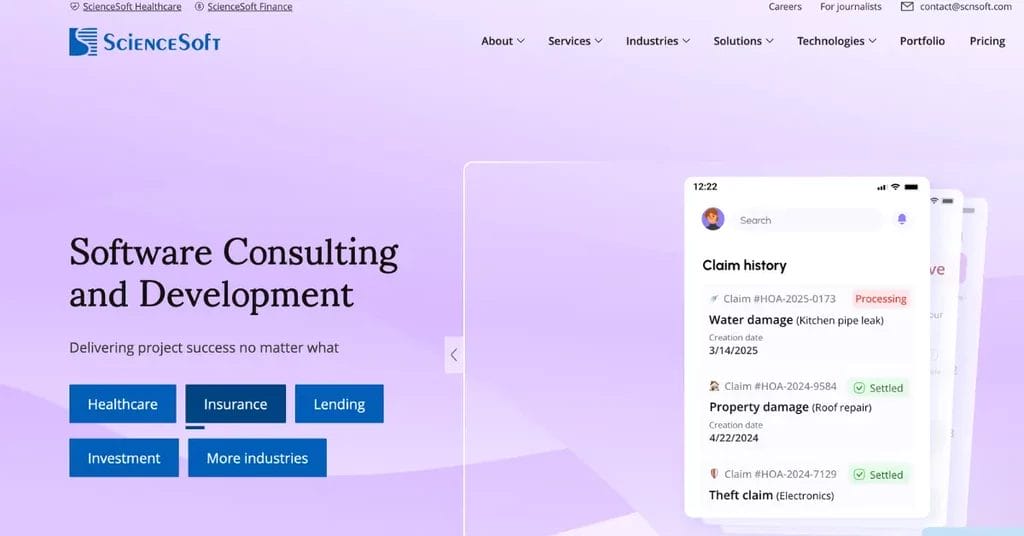
ScienceSoft is a U.S.-based global software and IT consulting company with 30+ years in healthcare. It builds HIPAA-compliant telehealth, EHR, and medical device systems while meeting ISO 13485 and FDA software validation standards.
The company has experience with major health institutions and life-science clients, focusing on governance, auditability, and reliability.
Best for: Mid-sized providers or MedTech firms needing full-cycle builds with strong compliance management.
3. Itransition
Key Services
- Website: itransition. com
- Founded: 1998
- Location: USA / Europe / CIS
- Employees: 1,000+
- Avg. Hourly Rate: Mid-range enterprise rate
- Minimal Budget: $25,000+
Itransition delivers enterprise-grade healthcare software including EHR/EMR systems, mobile health apps, and care coordination platforms. Their team follows HIPAA, HITECH, and HL7/FHIR standards and works with DICOM and ICD-10 data.
They support modernization of legacy systems, workflow automation, and multi-system interoperability for hospitals and insurers.
Best for: Large healthcare enterprises needing modernization and scalable compliance infrastructure.
4. HTD Health
Key Services
- Website: htdhealth.com
- Founded: 2016
- Location: USA / Poland
- Employees: 150+
- Avg. Hourly Rate: Custom
- Minimal Budget: $25,000+
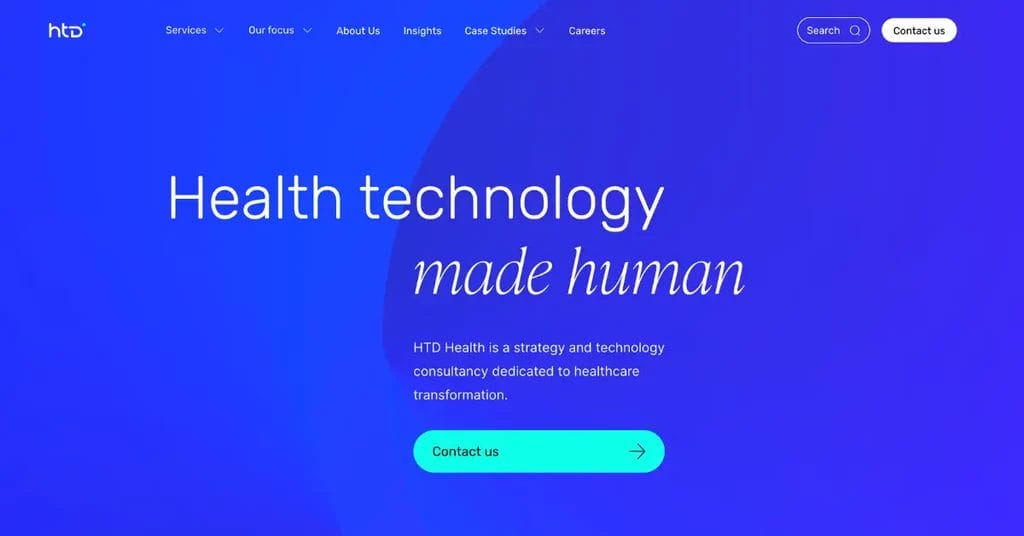
HTD Health combines healthcare strategy and product development. Their portfolio covers telehealth app development, digital therapeutics, and EMR integrations via FHIR.
The company blends clinical UX design with regulatory alignment, enabling providers to launch compliant, patient-centered digital products. With over 250 healthtech builds delivered, they’re recognized for design precision and interoperability expertise.
Best for: Organizations seeking domain-driven digital transformation with design and compliance built in.
5. OSP Labs
Key Services
- Website: osplabs. com
- Founded: 2009
- Location: USA / India
- Employees: ~200+
- Avg. Hourly Rate: $50–$99/hr
- Minimal Budget: $25,000+
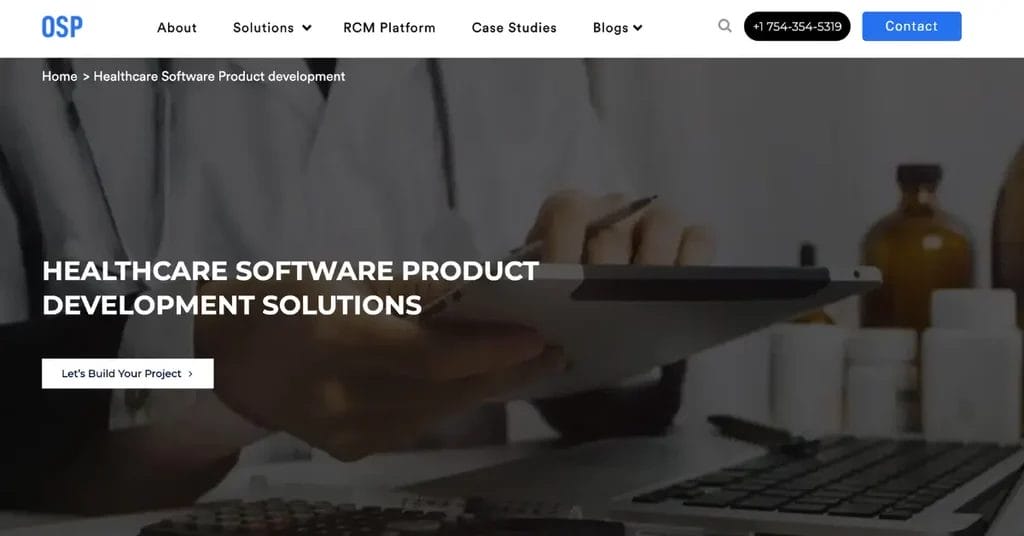
OSP Labs specializes in healthcare automation, EHR/EMR integration, telehealth systems, and revenue-cycle platforms. With ISO 9001, ISO 27001, and SOC 2 Type II certifications, OSP ensures regulatory alignment and data protection.
They focus on automating provider workflows, patient engagement, and claims processing while reducing administrative overhead.
Best for: Provider networks needing compliant software that connects seamlessly with existing hospital systems.
6. Empeek
Key Services
- Website: empeek. com
- Founded: 2015
- Location: Ukraine / USA
- Employees: 50-100
- Avg. Hourly Rate: $50–$99/hr
- Minimal Budget: $25,000+
Empeek delivers HIPAA- and GDPR-compliant software for healthcare startups and mid-sized providers. Their focus areas include telehealth, EHR integration, remote patient monitoring, and data-driven automation.
The firm’s outcomes-based approach has reportedly improved clinical efficiency and billing performance for clients. Their transparent communication and technical maturity make them a reliable nearshore partner.
Best for: Startups and care providers needing compliant MVPs and modernization support.
7. Simform
Key Services
- Website: simform. com
- Founded: 2010
- Location: USA + Offshore
- Employees: 1,000+
- Avg. Hourly Rate: $25–$49/hr
- Minimal Budget: $25,000+
Simform provides product engineering and cloud development for healthcare and other regulated industries. Their co-engineering model embeds agile pods within client teams to accelerate development.
The company works across cloud infrastructure, backend development, analytics, and app engineering with attention to HIPAA and SOC 2 practices.
Best for: Growth-stage healthtech firms needing scalable architecture and modern engineering processes.
8. Kanda Software
Key Services
- Website: kandasoft.com
- Founded: 1993
- Location: USA
- Employees: 200+
- Avg. Hourly Rate: $50–$99/hr
- Minimal Budget: $25,000+
Kanda Software has over 30 years of experience delivering healthcare and enterprise systems. They build HIPAA-compliant apps, integrate HL7 and FHIR APIs, and connect EMR platforms such as Epic and Cerner.
Their ISO 27001 and SOC 2 Type II compliance supports audit-ready builds, and their teams work on re-engineering legacy healthcare applications.
Best for: Health systems upgrading existing software or integrating new interoperability standards.
9. Saritasa
Key Services
- Website: saritasa. com
- Founded: 2005
- Location: USA / LATAM
- Employees: 100–249
- Avg. Hourly Rate: $50–$99/hr
- Minimal Budget: $25,000+
Saritasa builds mobile-first healthcare software that integrates with existing health systems. They iterate quickly and deliver polished apps that clinicians or patients can use day to day. Their strength is turning clinical requirements into clean, consumer-grade mobile experiences.
Best for: Consumer health products or frontline mobile health use cases.
10. TATEEDA
Key Services
- Website: tateeda. com
- Founded: 2013
- Location: USA / Offshore
- Employees: 50+
- Avg. Hourly Rate: $50–$99/hr
- Minimal Budget: $25,000+
TATEEDA builds software for healthcare, biotech, and diagnostics firms. They handle HIPAA and FDA compliance, IoT device connectivity, and medical data security.
Their engineers specialize in creating clinical dashboards, diagnostic platforms, and custom automation tools for regulated environments.
Best for: Biotech and diagnostic firms needing secure, compliant, custom software.
Cost & Timeline Benchmarks for Healthcare Software
Typical pricing and delivery windows for common healthcare software projects, based on scope and regulatory complexity.
How to Choose the Right Healthcare Software Partner
1. Domain proof matters
Telehealth, EHR, medical devices – pick partners who have built in your specific niche, and ask to see their portfolio.
2. Compliance credentials
Ask for HIPAA audit history, HITRUST, ISO 13485, or FHIR conformance testing. Cross-check certified health IT products against the ONC Certified Health IT Product List.
3. Ownership clarity
You must own your code, deployment, integrations, and documentation from day one – not just at contract end.
4. Prototype critical integrations
Try connecting to EHR, lab systems, or device APIs before committing to the full build.
5. Validate before full deployment
Launch core workflows – appointment booking, patient dashboard – before adding secondary features.
Compliance & Risk Controls Checklist
- Enforce HIPAA / HITECH / GDPR depending on jurisdictions
- Use encryption in transit and at rest
- Apply RBAC / 2FA / session controls
- Maintain immutable audit trails
- Segment data by compliance class and residency
- Introduce pen tests, code reviews, and drift audits each sprint
Why Technext Is a Reliable Partner for Any Healthcare Software Project
Technext’s fit is narrower than most companies on this list, and that’s the point: it’s built for startups and SMBs that need a compliant MVP without a $25K+ minimum.
1. Compliance engineered into architecture
Technext designs systems with HIPAA, HL7, and FHIR baked into the architecture from day one. Data encryption, access control, and audit logging are implemented at design level – not added later – reducing compliance rework and future audit costs.
2. Transparent ownership and zero vendor lock-in
Every project includes full access to repositories, deployment pipelines, infrastructure scripts, and documentation. Clients retain technical control, which means you can scale internally or change vendors without losing operational continuity.
3. Lean global delivery model
With teams in the U.S., UK, Canada, and Bangladesh, Technext blends U.S.-level communication with offshore software development efficiency. This hybrid model cuts build costs significantly while maintaining responsiveness and timezone coverage.
4. Proven healthcare and product experience
Beyond service work, Technext has built and scaled its own digital products – MailBluster, OneSuite, ThemeWagon, and Gradnet. That product DNA helps clients move from prototype to production quickly while maintaining reliability under load.
5. End-to-end support from discovery to handover
Each engagement includes compliance planning, UX design, engineering, DevOps, QA, and documentation. After launch, Technext provides infrastructure monitoring and knowledge transfer, ensuring teams can operate independently post-delivery.
FAQs
How much does healthcare software cost?
It depends heavily on domain complexity. A telehealth MVP might cost $80K–$150K; a full clinical system with EHR integration often passes $300K–$500K+.
How long does it take?
MVP to working prototype: 3–6 months. Full systems: 9–18+ months depending on regulation, device workloads, and integrations.
Why is healthcare software harder?
You must manage privacy, compliance, interoperability (HL7/FHIR), audit trails, clinical workflows, and device integrations from day one – a small issue can cascade into large liability.
Should hospitals build in-house or outsource?
If your team doesn’t already have compliance, device integration, and health-domain expertise, outsourcing is safer. But ownership and control must be non-negotiable.
How do I vet a healthcare software company quickly?
Ask for live case studies in healthcare, request audit documentation, check for data privacy certifications, test a sample EHR integration, and confirm handover from the start. Or get a free quote from Technext to talk through your specific build.
Ready to scope your healthcare project?
Building healthcare software means navigating HIPAA compliance, EHR integrations, and complex clinical workflows from day one. Whether you’re launching a telehealth MVP or modernizing a legacy system, getting the architecture right early saves months of rework and regulatory headaches down the line.
Talk to our team to get a clear picture of budget, timeline, and compliance requirements for your specific build.


Globally Recognised by B2B marketplaces

Kick start with your dedicated squad in Technext
Skip the hiring headache. NDA first, transparent rates, agile delivery from day-1.
No commitment • Reply within 2hrs

S. Polash
Sr. Engineer

Reza H.
Project Manager

Desh C.
Lead Developer

Imran K.
UI/UX Lead

